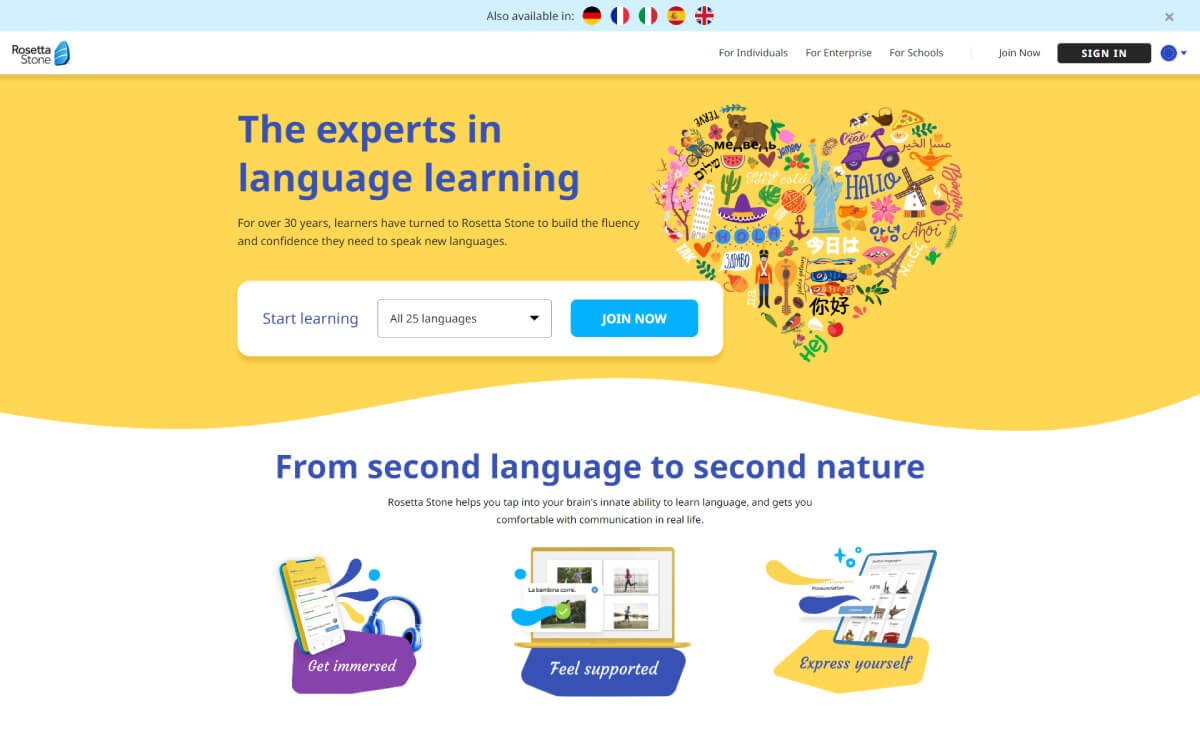
So, you're considering learning a new language, and the name "Rosetta Stone" has popped up – perhaps more than once. It’s a language learning giant, but the real question is: are its Rosetta Stone features, pros & cons a good fit for your learning style and goals? Picking the right tool can make all the difference between fluency and frustration. This guide cuts through the noise to give you a clear, honest look at what Rosetta Stone offers, helping you decide if it's your path to a new linguistic world.
At a Glance: Key Takeaways
- Core Method: "Dynamic Immersion" – teaches like you learned your first language, using images and context, no direct translations.
- Comprehensive: An "entire learning suite" including interactive software, mobile apps, "Stories," and optional Live Tutoring.
- Languages: Offers 24 languages, including popular and less common options, with specific regional variations (e.g., Spanish for Spain vs. Latin America).
- Key Strengths: Highly effective for intuitive learning, excellent visuals, strong speech recognition, flexible learning paths, offline capabilities.
- Potential Challenges: Requires openness to a non-traditional method, can feel slow for advanced learners, limited explicit cultural immersion.
- Pricing: Flexible monthly or "Lifetime" subscriptions, with Live Tutoring as an add-on. Frequent discounts are common.
- Recommendation: Worth trying for its unique, proven method, especially with its free trial and money-back guarantee.
Decoding the Dynamic Immersion: Rosetta Stone's Core Philosophy
At the heart of Rosetta Stone's enduring appeal is its signature "Dynamic Immersion" method. Forget rote memorization, explicit grammar rules, or endless vocabulary lists. Rosetta Stone takes a radically different approach: it aims to teach you a new language the same way you learned your native tongue – intuitively, subconsciously, and without direct translation.
Imagine being a child again, experiencing the world and associating words directly with images, actions, and contexts. That's the essence of Dynamic Immersion. Instead of saying, "Hola means Hello," Rosetta Stone shows you a person waving and says "Hola." You see a girl, a boy, and they say "La niña," "El niño." Slowly, these individual words build into complete sentences, creating meaning through cleverly designed visual and auditory cues.
This method works with specially produced and optimized images, resolving any ambiguity by combining different visuals for the same term. All content is read aloud by native speakers, and exercises involve associating what you hear with what you see, repeating phrases, or typing out sentences. It's a full-sensory experience designed to bypass the translation reflex and get you thinking directly in the target language. For over three months, talkREAL put this method to the test, focusing intensely on Spanish and exploring other languages like Hebrew, Russian, and English, consistently finding it to be one of the "Best Learning Methods" available.
A Deep Dive into Rosetta Stone's Feature Set
Rosetta Stone isn't just an app; it's a complete learning ecosystem. It calls itself an "entire learning suite" for a reason, packing various tools into one cohesive experience.
The Full Learning Suite: More Than Just Lessons
Your Rosetta Stone online access opens the door to a rich environment. This includes the core interactive software lessons, a mobile app for learning on the go, "Extended Learning" content like Audio Companion and "Stories," and optional Live Tutoring sessions. While some older features like "Play" games and a community section have been phased out, the current suite focuses on robust, guided learning.
Interactive Software & Exercise Types
The core lessons are a series of interactive exercises that guide you through new vocabulary and grammatical structures. You'll see images and hear words, then perform tasks like:
- Matching: Connecting spoken words to corresponding images.
- Pronunciation Practice: Speaking into your microphone and getting immediate feedback.
- Writing: Typing out words and sentences based on what you see and hear.
- Grammar Deduction: Choosing the correct form of a verb or noun based on visual cues.
This repetitive, building-block approach reinforces learning without ever explicitly defining a rule.
Grammar & Syntax Without Rules
One of Dynamic Immersion's most distinct aspects is the absence of traditional grammar explanations. You won't find conjugation tables or lengthy descriptions of subjunctive mood. Instead, grammar rules are subconsciously derived. As you progress, you'll notice clever color-coding in illustrated exercises that subtly highlight agreement or tense changes. Your brain picks up the patterns intuitively, much like a child learns correct sentence structure through constant exposure rather than formal lessons.
Mastering Your Pronunciation: Speech Recognition
Rosetta Stone's speech recognition technology is generally robust and a standout feature. It provides immediate feedback on your pronunciation via color-coding – green for good, yellow for okay, red for needing work. While it can be quite lenient in the very early stages to build confidence, you can adjust its precision in the settings as you advance. It even helps you practice intonation, which is crucial for sounding natural. For optimal performance, especially when using a laptop, a headset is highly recommended.
Tackling New Alphabets: Foreign Script Input
For languages that don't use the Latin alphabet, like Russian (Cyrillic), Korean, or Arabic, Rosetta Stone makes script input manageable. An on-screen keyboard is readily available, allowing you to click characters. Additionally, special characters can often be accessed directly via your physical keyboard using specific key combinations, making the typing exercises smooth even for complex scripts.
Learning on the Go: The Mobile Apps & Offline Access
The accompanying mobile apps (available for iOS and Android) offer full functionality, mirroring the desktop experience. Your progress synchronizes seamlessly across all devices, meaning you can start a lesson on your computer and pick it up exactly where you left off on your phone. A particularly valuable feature is the ability to download content within the apps for offline learning. This makes Rosetta Stone an excellent companion for commutes, flights, or any time you want to learn without an internet connection. The exercise duration display, a feature previously critiqued for its absence, has thankfully been reintroduced. The talkREAL reviewer found themselves using the apps for 80% of their learning, highlighting their effectiveness and convenience.
Real-World Practice: Live Tutoring Sessions
For those seeking active speaking practice, Rosetta Stone offers optional Live Tutoring. These 25-minute virtual classroom sessions are led by native-speaking teachers and typically involve small groups of learners, or sometimes even one-on-one. The focus is entirely on active conversation, reinforcing topics from your core lessons through engaging Q&A and guided discussions. Since 2020, these "Rosetta Studio Sessions" have become an optional add-on, allowing you to customize your learning package.
Personalized Paths: Goal Setting & Level Choice
Rosetta Stone recognizes that learners have diverse motivations. Its newer learning path allows you to choose your starting level and set personal learning goals. Whether you're aiming for conversational fluency for travel, professional use, or simply want to pick up a few phrases for fun, you can tailor your journey. This flexibility ensures the content aligns with what matters most to you.
The Language Line-Up
With a total of 24 languages available, Rosetta Stone covers a wide spectrum. Beyond popular choices like Spanish, French, German, and Italian, you can delve into Korean, Persian (Farsi), Polish, Portuguese (Brazilian), Russian, Swedish, Turkish, Vietnamese, and many more. The option to choose between regional variations, such as Spanish for Spain or Latin America, adds a layer of practical relevance.
The Upside: Why Learners Love Rosetta Stone (Pros)
Rosetta Stone has earned its reputation for a reason. Its unique approach offers several compelling advantages for language learners.
- Intuitive, Brain-Friendly Learning: The "Dynamic Immersion" method is highly effective because it mimics natural language acquisition. It bypasses the need for constant translation, encouraging you to think directly in the target language. This intuitive learning sticks with you, building a subconscious understanding that's hard to achieve with traditional methods.
- Excellent Visual Quality & Production: The custom-produced images are not just pretty; they are optimized to convey meaning clearly and resolve ambiguities. This high visual quality is a consistent strength, making the learning process engaging and easy to follow.
- A Complete Ecosystem for Learning: From interactive software to mobile apps, Audio Companions, "Stories," and optional Live Tutoring, Rosetta Stone provides a comprehensive suite. It's an "entire learning suite" designed to support different aspects of language acquisition.
- Flexibility & Convenience: The ability to download content for offline learning, synchronize progress across devices, and utilize robust mobile apps means you can learn whenever and wherever it suits you. Combined with personalized learning paths, it adapts to your schedule and goals.
- Boosting Your Speaking Confidence: The adjustable and generally robust speech recognition, coupled with the opportunity for live practice in small groups with native teachers, provides excellent avenues for improving pronunciation and active speaking.
- Appeals to Diverse Learning Styles: Whether you're a visual learner who thrives on images, an auditory learner who benefits from hearing native speakers, a kinesthetic learner who enjoys repeating and typing, or a literary learner who appreciates structured progression, Rosetta Stone offers elements that cater to you.
- Risk-Free Exploration: Rosetta Stone offers a 3-day free trial, allowing you to experience Dynamic Immersion firsthand. Further, a 30-day money-back guarantee means you can commit with confidence, knowing you have a safety net if it doesn't align with your expectations. If you're wondering Should you get Rosetta Stone? then taking advantage of these trials is a smart first step.
The Other Side of the Coin: Potential Drawbacks (Cons)
No language learning tool is perfect for everyone, and Rosetta Stone has a few aspects that might not suit every learner.
- It's Different: Adapting to Dynamic Immersion: While highly effective, the non-traditional method requires a certain openness. If you're used to explicit grammar explanations and direct translations, the initial lack of these might feel disorienting or even frustrating. You need to trust the process and let go of preconceived notions about how language learning should work.
- Missing Motivators? In the past, Rosetta Stone included engaging learning games and a community section ("Play" and "Talk"). These features have since been removed. For learners who thrive on gamification and social interaction, their absence might lead to a perceived lack of motivating elements beyond the core lessons.
- Cultural Nuance Limitations: Because Rosetta Stone uses largely the same images across all languages, it can sometimes lack deep cultural immersion. While it teaches you the language effectively, it doesn't always provide rich insights into the cultural context, customs, or societal nuances associated with that language.
- Pacing for Experienced Learners: If you already have some prior knowledge of a language, especially in the initial stages, Rosetta Stone's deliberate, building-block approach can feel slow or even tedious. You might find yourself wanting to skip ahead, which isn't always smoothly facilitated within the highly structured curriculum.
- The Initial Translation Challenge: For complete beginners, especially with entirely foreign languages, the complete absence of direct English translations can be genuinely challenging at first. There's a learning curve to trusting the visual cues and context, which requires patience.
- Self-Motivation is Key: With the removal of community features and games, and the sometimes slower pace, Rosetta Stone requires a good degree of self-motivation. It provides the tools, but you need to bring the consistent effort to fully benefit from the program.
- Pricing Evolution: Historically, Rosetta Stone prices were perceived as high. While past models like €399 for downloads or €219 for 6-month online access could be steep, the company has introduced new pricing structures and frequently offers significant discounts, making it more accessible now. However, Live Tutoring is an optional add-on, which means the most comprehensive experience comes at an additional cost.
Rosetta Stone's Evolving Pricing: What to Expect
Rosetta Stone has significantly updated its pricing models over time, moving towards more flexible and accessible options. Gone are the days of single, high upfront costs for software.
Subscription Models: Monthly or Lifetime
Currently, you'll find two primary pricing structures:
- Monthly Subscriptions: These offer access to Rosetta Stone for a recurring fee, typically billed monthly or quarterly. This is a good option if you want to try it out for a shorter period or prefer a pay-as-you-go approach.
- "Lifetime Subscription" (All Languages for Life): This is arguably the most popular and value-driven option. For a one-time payment, you gain lifelong access to all 24 languages Rosetta Stone offers. This "Rosetta Stone Unlimited" concept is excellent for ambitious polyglots or those who plan to learn multiple languages over time.
Live Tutoring as an Add-On
It's important to note that Live Tutoring sessions are now typically an optional add-on. While some premium bundles might include them, they are generally purchased separately from your core subscription. This allows you to decide if you want to invest in live interaction or rely solely on the self-paced materials.
Why Discounts Are Your Friend
Rosetta Stone is renowned for its frequent and substantial discounts, especially on the "All Languages for Life" offer. These promotions can be time-limited, so if you're seriously considering a purchase, keep an eye out for sales events, particularly around holidays or special campaigns. A significant discount can make the Lifetime Subscription an incredibly cost-effective investment in your language future. Before making a final decision, it's always wise to check the current promotions.
Is Rosetta Stone Your Language Learning Partner?
After dissecting Rosetta Stone's features, strengths, and potential challenges, the question remains: Is it the right tool for you? The talkREAL review, after testing the platform for over three months, strongly recommends trying Rosetta Stone due to its unique and effective "Dynamic Immersion" method, high-quality execution, and comprehensive offerings.
Who It's Best For:
- True Beginners: If you're starting a language from scratch and are open to a non-traditional method, Rosetta Stone excels at building foundational intuition.
- Visual & Auditory Learners: The heavy reliance on images and native audio is incredibly effective for these learning styles.
- Those Who Trust the Process: If you're willing to embrace a different learning approach and let go of traditional grammar-first beliefs, you'll likely thrive.
- Independent Learners: While Live Tutoring adds interaction, the core program is self-paced, suiting those who prefer to learn on their own schedule.
- Aspiring Polyglots: The "All Languages for Life" subscription is unbeatable value if you plan to learn more than one language over time.
Who Might Need Alternatives:
- "Grammar Nerds": If you absolutely need explicit grammar explanations and rules laid out, Rosetta Stone's approach might frustrate you.
- Highly Experienced Learners: Those with advanced proficiency in a language might find the initial stages too slow and repetitive.
- Social Learners: If community interaction, games, and direct peer-to-peer practice are crucial motivators, you might find Rosetta Stone a bit solitary.
- Budget-Conscious Learners (Without Discounts): While frequently discounted, the upfront cost for a Lifetime subscription (without a sale) can still be a significant investment, especially if you're only learning one language.
The Try-Before-You-Buy Approach
Ultimately, the best way to determine if Rosetta Stone aligns with your learning style is to experience it yourself. Take advantage of the 3-day free trial to immerse yourself in a language of your choice. Pay attention to how the Dynamic Immersion method feels. Do you find yourself making connections intuitively? Does the lack of direct translation feel liberating or frustrating?
If the trial piques your interest, the 30-day money-back guarantee offers further peace of mind. You can commit to a subscription with the confidence that you have a full month to fully evaluate its effectiveness before making a long-term decision. In the ever-growing landscape of language learning tools, Rosetta Stone remains a premium, high-quality option, but its unique methodology requires a willing learner. Don't just read about it; experience it, and let your brain decide.